Florida Property Tax Puzzle: Unlocking the Code

All 50 US states (and the District of Columbia) collect property taxes, primarily through local governments such as counties, cities, school districts, and special districts. These taxes fund essential services like schools, roads, police, and fire departments. There is no state that directly assesses property taxes.
Property taxes are levied on real property (land and buildings) and sometimes personal property (e.g., business equipment or vehicles), though real property taxes are the main focus and are universal across states. No state completely eliminates property taxes, as they are a core revenue source for local governments—accounting for about 70% of local tax collections nationwide.
Rates vary significantly by state and locality:
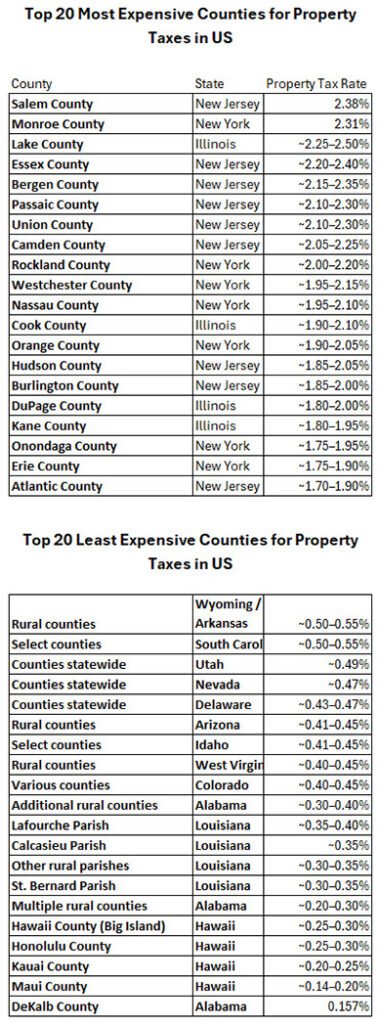
- Highest effective rates are often in states like New Jersey, Illinois, and Connecticut.
- Lowest in states like Hawaii, Alabama, and Louisiana.
Some areas (e.g., certain remote parts of Alaska or specific parishes in Louisiana) may have very low or no local property taxes in practice, but this is not statewide. Exemptions, credits, or caps exist in many places (e.g., for homesteads, seniors, or veterans), but the tax itself is present everywhere.
How are property taxes calculated
Property taxes around the country, at a high level are calculated by a taxing district that is usually a county level of government. The taxing district will calculate a total taxable value of all real property in the taxing district. Within each taxing district the services provided, police, fire, schools, etc., will create a budget and divide it by the total taxable value of all property in the district and this will create what is known as the millage rate.
What Is a Mill?
- 1 mill = $1 in tax for every $1,000 of taxable value
- A millage rate of 10.0 equals $10 per $1,000 of taxable value




How is the tax bill calculated
The taxing district will add up all millage rates from the different services and multiply the taxable value of a property times the total millage rate.
What is my property taxable value
Each taxing district has it’s own method of calculating the taxable value of a property. At the core of the formula is the fair market value of the property at the time you purchase. Usually this will be the price you buy the property for, but in some cases if the purchase price is significantly different from a fair market value, the taxing authority will use the fair market value. Some taxing districts calculate the market value each year for the property.
Some taxing districts offer certain exemptions and rules to calculating the fair market value. Some districts limit the amount of change to property value to a maximum increase percentage each year you live in a home. In that case if you purchase a home for $100,000 your fair market value would be $100,000 the first taxable year. If the market value increases by 10% the next year, your fair market value would be $110,000. But the taxing district may limit valuation increases to a fixed percentage, example 3%, so the taxable value would only increase to $103,000.
Each taxing district has their own types of exemptions, senior discounts, homestead exemptions, veterans, etc. Consult your local taxing authority for your exact rules for calculating your taxable value.
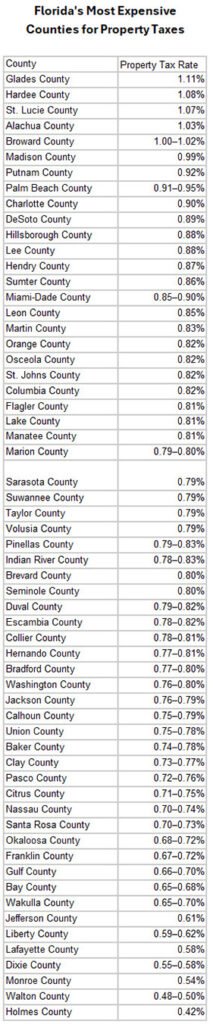
Below is a table that shows the highest to lowest effective tax rate for counties across the US